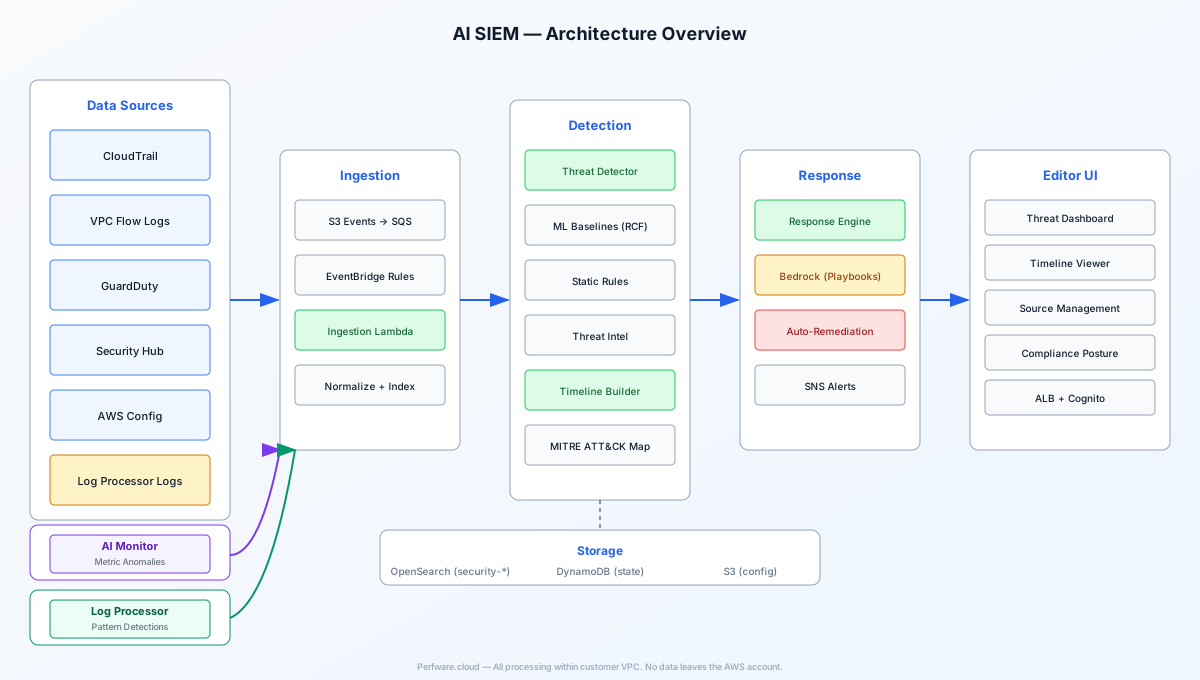
Correlate CloudTrail, VPC Flow Logs, GuardDuty findings, and application events into a unified threat timeline. ML-driven behavioral analysis, real-time alert triage, and guided incident response — all running in your account.
Subscribe on AWS Marketplace Learn MoreAWS provides powerful security services, but they're fragmented. Without correlation, teams can't see the full picture:
AI SIEM unifies all your AWS security signals into a single, intelligent platform:
Everything you need for AWS-native threat detection and response.
Events from CloudTrail, VPC Flow Logs, GuardDuty, Config, and Security Hub merged into a single chronological incident view per threat actor.
Learns what "normal" looks like per IAM principal — which APIs, which times, which IPs, which resources. Alerts on deviations without manual threshold tuning.
Automatically connects related events: compromised credential + unusual S3 access + port scanning + GuardDuty alert = one correlated threat.
Events automatically mapped to ATT&CK tactics and techniques. Visual kill chain progression shows how far an attack has advanced.
Bedrock generates contextual step-by-step remediation guidance based on the specific threat, affected resources, and your environment.
Enterprise tier: automatically disable compromised keys, revoke sessions, isolate instances, and block IPs. Opt-in per action type with full audit trail.
Continuous scoring against SOC2, PCI, and HIPAA controls based on security events. Weekly posture reports with trend analysis.
IP reputation enrichment from open threat feeds. Source IPs in CloudTrail and VPC Flow Logs tagged with known-malicious indicators.
Shares OpenSearch with Log Processor for cross-domain correlation. When AI Monitor detects anomalous metrics during a security event, both signals are connected.
AI SIEM, Log Processor, and AI Monitor share infrastructure and reinforce each other. Each product works standalone; together they cover the full kill chain at a fraction of the cost of any one competitor.
Continuous full flow-log ingestion is prohibitively expensive at scale. AI Monitor watches VPC network metrics at 1-minute resolution for near-zero cost. When it detects an anomalous volume spike, AI SIEM temporarily enables detailed flow logging for just that VPC — capturing destination IPs, port details, and session data for the minutes that matter, then turns it off.
Result: full forensic detail around incidents at pennies, not thousands per month. A capability no competitor offers at this price point.
AI Monitor detects infrastructure anomalies (CPU spike on an idle instance, sudden database connection surge, EBS write volume explosion). AI SIEM detects security events (IAM changes, credential probing, privilege escalation). When both fire on the same resource within the same window, the threat timeline shows both signals together.
Example: "A role policy was modified, then CPU spiked to 100% on three instances, and network egress jumped 50x" — that's a complete attack narrative, not three unrelated alerts.
GuardDuty and CloudTrail observe infrastructure. They cannot see your application’s auth system, your API error rates, or your database query patterns. Log Processor can — it ingests your application and service logs and runs pattern detection: error spikes, latency anomalies, crash loops, and unusual query patterns.
When Log Processor detects an application-layer anomaly, that finding feeds directly into AI SIEM’s threat timeline. A credential brute-force visible only in your API’s 401 responses, an SQL injection manifesting only as slow queries, or a defence-evasion move revealed only by missing logs — all surface as correlated security events alongside the infrastructure signals.
This closes the biggest gap in AWS-native security: attacks that operate within permissions an application already has, never touching IAM, invisible to every infrastructure-layer tool.
All three products share one OpenSearch cluster (Log Processor owns it), one VPC, and one set of IAM roles. No additional domains, no redundant storage, no duplicated ingestion. AI SIEM adds security analytics on top of what's already running — incremental cost, not another $50K line item.
Deploy in 15 minutes. Start detecting threats immediately.
Single CloudFormation stack deploys on your existing Log Processor VPC and OpenSearch domain. No new infrastructure to manage.
Point to your CloudTrail bucket, enable VPC Flow Logs, and GuardDuty + Security Hub events flow automatically via EventBridge.
ML models learn normal behavior per principal within 7–14 days. Static rules catch known-bad patterns immediately.
Threats surface with full timeline context, MITRE mapping, and AI-generated playbooks. Enterprise tier can auto-remediate.
Software fee only. AWS infrastructure costs are billed directly by AWS to your account.
Yes. AI SIEM deploys on the VPC and OpenSearch domain created by Log Processor. This avoids duplicating infrastructure and enables cross-domain correlation between logs, metrics, and security events.
No. All processing happens within your account. The only external call is an entitlement check to verify your Marketplace subscription (no customer data is transmitted).
Static rules (known-bad patterns like impossible travel, credential stuffing) fire within minutes of event ingestion. ML behavioral anomalies require a 7–14 day baseline learning period before alerting.
Enterprise tier only, opt-in per action type: disable IAM access keys, revoke active sessions, attach deny-all policies, modify security groups to isolate instances. Every action is logged to DynamoDB with full audit trail.
AI SIEM correlates all of those into a single timeline with behavioral ML that learns YOUR account's normal patterns. GuardDuty detects; AI SIEM correlates, explains, and responds. Security Hub aggregates; AI SIEM connects the dots into attack narratives.
Depends on event volume. Typical: $20–$80/mo for Lambda, S3, DynamoDB, and Bedrock. OpenSearch is shared with Log Processor (no additional cluster cost). CloudTrail and VPC Flow Logs have their own AWS charges regardless of AI SIEM.
Yes, and this is where the platform becomes more than the sum of its parts. All three products share one OpenSearch domain and EventBridge bus, so integration is zero-infrastructure.
AI Monitor watches CloudWatch metrics (CPU, network, database connections) and feeds anomaly detections into AI SIEM’s threat timeline. When both detect activity on the same resource within the same window, you get a complete attack narrative: the IAM change that enabled it (CloudTrail), the metric spike that revealed it (AI Monitor), the network flows that show where data went (VPC Flow Logs), and an AI-generated playbook to stop it. For severe network anomalies, AI SIEM can automatically enable detailed flow logging for just those minutes — capturing forensic detail at pennies instead of thousands per month.
Log Processor ingests application and service logs and runs pattern detection on them. When it detects an error spike, unusual query patterns, a crash loop, a spike in failed login attempts against your app's own auth system, or a sudden log-volume drop, that finding feeds directly into AI SIEM as a correlated event. This closes the biggest gap in AWS-native security: attacks that operate within permissions an application already has — never touching IAM, invisible to CloudTrail and GuardDuty — surface as security events only because Log Processor saw the application-layer anomaly.
See the integration section for architecture detail and competitive advantages.
Update the Tier parameter in CloudFormation and run a stack update. Non-destructive — all data is preserved. Feature gates activate immediately.
Guides for deployment, configuration, and daily operations.